
-
Liquid Nitrogen Containers
-
 Small Portable Liquid Nitrogen Container
-
 Transportable Liquid Nitrogen Tank
-
 Standard 50mm Caliber Liquid Nitrogen Flask
-
 Big Caliber Liquid Nitrogen Cylinder
-
 Liquid Nitrogen Dewar For Cell Storage
-
 Liquid Nitrogen Vessel For Bueaty
-
 Animal Semen Storage Ln2 Tank
-
 Cryogenic Liquid Nitrogen Dewar
-
 YDS-30-125 Liquid Nitrogen Storage Container
-
 2 Liter Liquid Nitrogen Container
-
- Stainless Steel Tank
- Customized Tank
- Liquid Nitrogen Generator
- Industries


How a Liquid Nitrogen Tank “Freezes Time”: Inside −196 °C
15-Oct-26
A liquid nitrogen tank is often described as a container that "freezes time". Behind that phrase lies a complete set of thermodynamic design choices.
Time is the enemy of any biological sample. Molecules inside a cell are never still: the higher the temperature, the more vigorous the motion, and the faster degradation and metabolism proceed. Liquid nitrogen boils at roughly −196 °C. Immersed in that environment, molecular thermal motion is sharply reduced, biochemical reactions come almost to a halt, and samples can retain their original state over long periods.
The real challenge is not cooling but insulation. Producing liquid nitrogen is relatively straightforw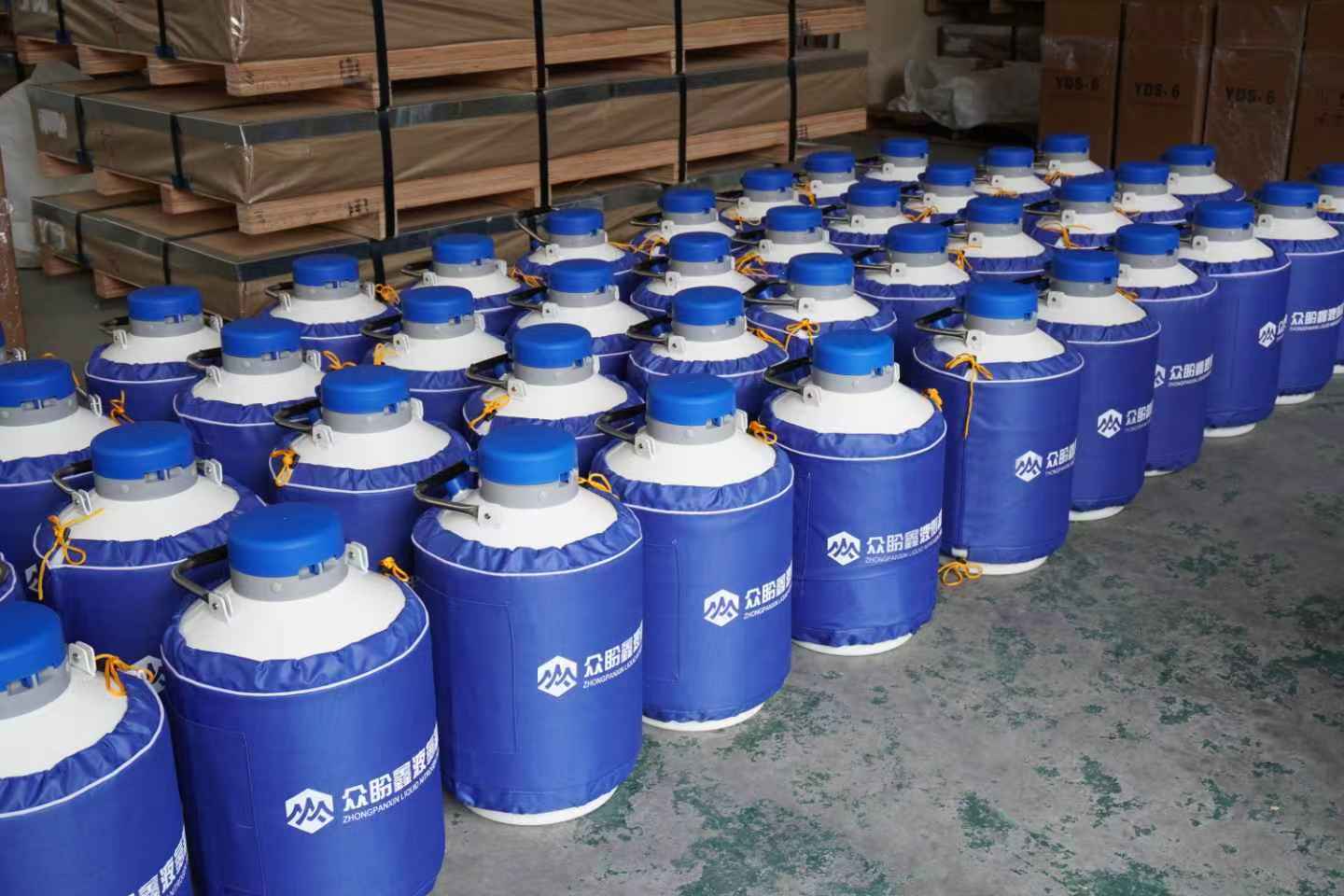 ard; keeping it is not. Heat always seeps in from the surroundings through conduction, convection and radiation, and tank design addresses each path in turn. A high vacuum between the inner vessel and outer shell eliminates conduction and convection through air. Multi-layer reflective shielding wrapped around the interspace bounces radiant heat back layer by layer. The neck tube is made narrow and long to shrink the cross-section of the main heat-exchange channel at the opening. Thanks to these measures, the tank can hold cryogenic temperatures for weeks with no external power supply.
ard; keeping it is not. Heat always seeps in from the surroundings through conduction, convection and radiation, and tank design addresses each path in turn. A high vacuum between the inner vessel and outer shell eliminates conduction and convection through air. Multi-layer reflective shielding wrapped around the interspace bounces radiant heat back layer by layer. The neck tube is made narrow and long to shrink the cross-section of the main heat-exchange channel at the opening. Thanks to these measures, the tank can hold cryogenic temperatures for weeks with no external power supply.One misconception is worth clarifying: a liquid nitrogen tank never stops consuming its contents. Constrained by materials and manufacturing, heat still penetrates slowly and nitrogen continues to evaporate. This is what the "static evaporation rate" on the nameplate measures — the daily loss under static conditions — and it serves as a key indicator of insulation performance.
In practice, it is advisable to monitor liquid levels regularly, keep the storage area ventilated and allow a generous margin for long-distance transport. Understanding how a tank fights heat ingress is, in the end, understanding how it quietly preserves sample viability.
- Products Category
- Liquid Nitrogen Containers
- Stainless Steel Tank
- Customized Tank
- Liquid Nitrogen Generator
- Industries
- Lasted Blogs
- Why Temperature Inside a Liquid Nitrogen Tank Is Not Uniform Oct 16,2026
- How a Liquid Nitrogen Tank “Freezes Time”: Inside −196 °C Oct 15,2026
- Why Should a Liquid Nitrogen Tank Not Be Placed Directly on a Concrete Floor? — Corrosion and Protection Sep 03,2026
- Why Must a Liquid Nitrogen Tank Be Pre-Cooled Before Use? — Preventing Thermal Shock Sep 02,2026
 Free Quote
Send message
Free Quote
Send message

Xinxiang Zhongpanxin Industry Co.Ltd. is mainly specialized in manufacturing liquid nitrogen container, liquid nitrogen freezer, liquid level gauge, liquid level monitor, livestock husbandry tools for almost two decades.
 Products